Maisson Hassan Matar
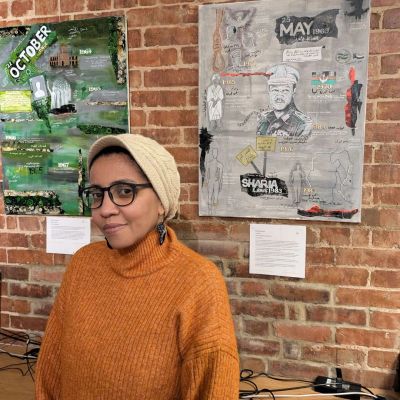
Sudan: Stolen Dreams is both an artwork and a historical testimony. Through a visual timeline of Sudan's modern history, Maisson Hassan Matar traces decades of military coups, dictatorship, popular uprisings, and conflict, revealing how generations of Sudanese people have seen their hopes for democracy repeatedly interrupted.
The work is deeply personal. Growing up under Omar al-Bashir's regime, Maisson witnessed political repression, war, discrimination against women, and the suppression of fundamental freedoms. Rather than leaving her country behind, she chose to become a social activist, believing that every citizen has a responsibility to stand alongside the most vulnerable and fight for a democratic future.
Today, like millions of Sudanese people, Maisson has been displaced by war. Sudan: Stolen Dreams is both a record of collective memory and a tribute to the resilience of a people who continue to demand freedom, justice, and peace. It reminds us that while dreams can be stolen, hope and the determination to rebuild endure.
Maisson Hassan Matar is a Sudanese artist, human rights advocate, and social activist whose work explores democracy, displacement, memory, and resilience. Drawing on her lived experience of dictatorship, revolution, and forced displacement, she creates artworks that document Sudan's recent history while giving voice to those whose stories are often overlooked.
Her practice combines personal testimony with historical research, transforming art into a space for remembrance, dialogue, and civic engagement. Through her work, Maisson seeks to preserve collective memory, promote human rights, and inspire hope for a democratic and peaceful Sudan.
Maisson's work honours the courage of the Sudanese people who have continued to demand democracy despite decades of dictatorship, conflict, and displacement. It reminds us that human rights are not only about individual freedoms, but also about the collective right of people to shape the future of their own country.
Article 21 of the Universal Declaration of Human Rights
"The will of the people shall be the basis of the authority of government; this will shall be expressed in periodic and genuine elections."
Sudan: Stolen Dreams

Sudan: Stolen Dreams 1956
Sudan: Stolen Dreams 1964
Sudan: Stolen Dreams 1970
Sudan: Stolen Dreams 1983
Sudan: Stolen Dreams 1989
Sudan: Stolen Dreams 2018
Sudan: Stolen Dreams 2023
Preserving Your Precious Memories
A letter from Maisson
My earliest memory is vivid. In 1985, I was seven, standing with my family outside my grandparents' house, which overlooked the airport. We witnessed a seemingly endless stream of people. Young and old, men, women, and children, marched with a unified, powerful voice. Their voices, strong and unwavering, pulsed through the air. Clueless, I turned to my mother, who explained they were protesting against Nimeiri's regime. We joined them.
Four years later, the fragile democracy that followed was snatched away by al-Bashir's coup. I grew up under his oppressive rule, witnessing the damage inflicted on Sudan and its people. In the 90s, the war with South Sudan was fueled by the forced recruitment of young men, and turned them into pawns in a so-called Jihad, only to be declared martyrs by a deceitful government. The genocide in Darfur and South Kordofan. The corruption and the suffocating laws, especially against women. The Public Order Law, which was a shackle on our freedom of expression.
This regime stole a large chunk of my life. Regardless, I refused to leave Sudan. This land, fractured as it may be, was still my home. I couldn't abandon it to the clutches of those who sought to exploit its vulnerabilities. Instead, I chose to become a social activist, a voice for the voiceless. We, the Sudanese people, had a responsibility to each other, especially the most vulnerable. If we all left, who would fight for the future we so desperately craved? Who would nurture the seeds of hope amidst the ashes? I wouldn't let Sudan become a lost cause. My dream of a democratic nation, where my daughters could flourish, wouldn't die. It would fuel my fight.
After three decades, I found myself back on the streets, this time against al-Bashir. For six grueling months, we raised our voices, demanding democracy. Many friends and family members were lost, their peaceful protests silenced forever. But we managed to remove al-Bashir in April 2019, however, our success was short-lived. Al-Bashir's generals and militia, plunged the country back into war. Now, displaced like millions of others, I seek refuge. My family, scattered.
Despite everything, my love for Sudan runs deep. It's a complex bond – a love-hate relationship. The history, the rich diversity, the vibrant culture of my people – these fill me with pride. But the actions of our own governments leave me filled with anger and frustration.
For years, I've dreamt of a different Sudan, a democratic nation where the voices of the people are heard and respected. A place where my daughters can grow up with dignity. My dreams were stolen!
Maisson Hassan Matar